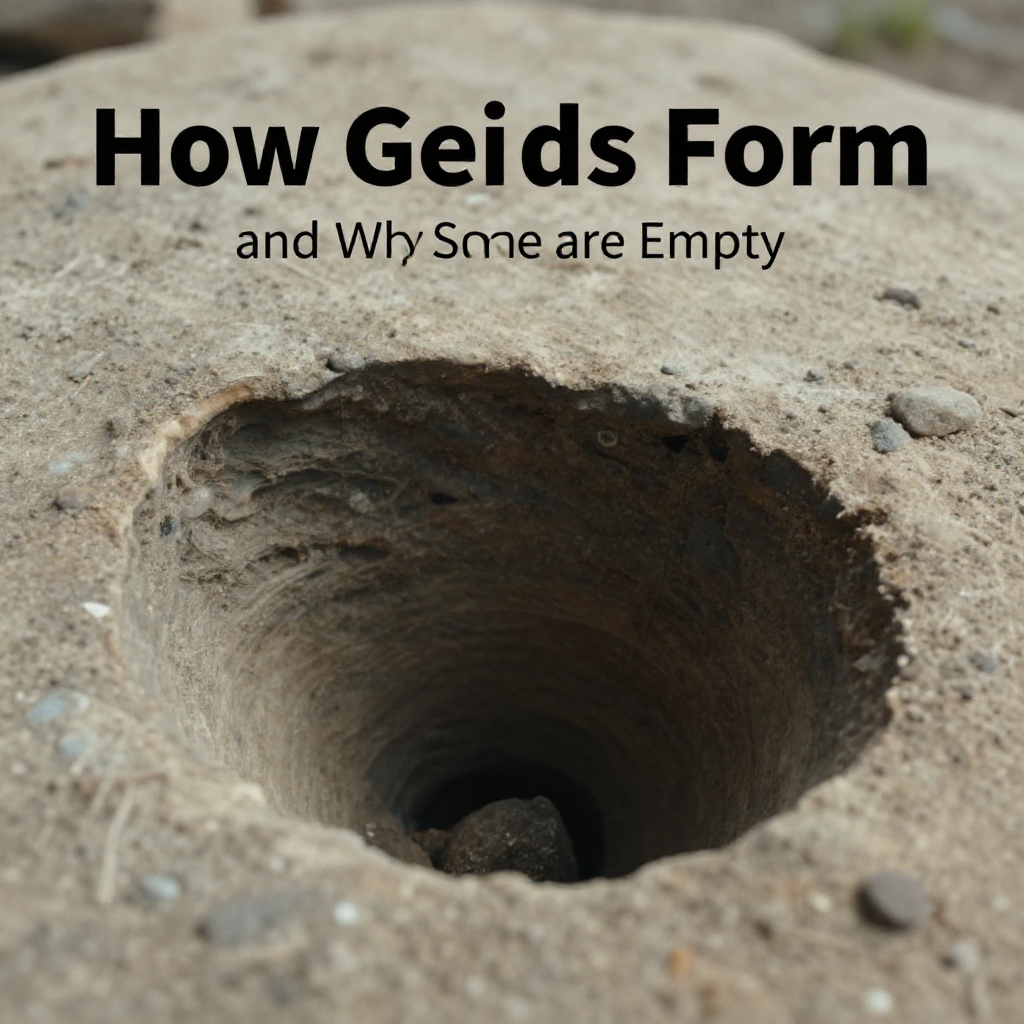
Crack open a geode and you are betting on a process that ran for an unknown length of time, with no scorecard telling you how far it got before you found the rock. Understanding how geodes form explains why: sometimes the process finished, more often it didn't, and neither outcome means the rock failed at being a geode.
A Geode Starts as Nothing
Every geode begins as empty space. In volcanic rock, that space is usually a gas bubble, a pocket trapped inside cooling lava as it hardens around escaping gas, the same way holes form in a sponge cake as it bakes. In sedimentary rock, the cavity more often comes from a different route: a nodule, root, or shell dissolves out from the inside, leaving a void surrounded by a harder rock shell that never dissolved. Either way, what's left is a sealed pocket with room inside and nothing in it yet. Whether that pocket ever fills with anything worth cracking open for depends entirely on what happens after it forms.
Groundwater Does the Actual Work
Once the cavity exists, it waits. Groundwater carrying dissolved silica, the mineral behind both quartz and chalcedony, moves through cracks in the surrounding rock and seeps into the hollow. As conditions inside the cavity shift, temperature, pressure, acidity, the water can no longer hold that silica in solution, so it drops out and settles on the cavity wall. This happens in thin layers, one pass of water at a time, each one adding a little more material before conditions change again or the water supply recedes for a while.
Why the Fill Builds Inward, Not Outward
Deposition inside a geode always stacks from the outer wall toward the center, layer over layer. That's why a cut cross-section shows banding: concentric rings of chalcedony or agate close to the shell, sometimes giving way to a final layer of coarser quartz crystals pointing inward at whatever space is left. The mechanics of that layering, and how it differs from the way crystals grow in open space, are covered in more depth in geology explained.
Why Crystal Size and Fill Vary So Much
Three variables decide what you find when you finally split a geode open: how much mineral-saturated water passed through the cavity, how long the process had to run before it stopped, and how much open space the cavity started with. A large bubble takes far more dissolved silica to fill than a small one, so two cavities fed by the same groundwater supply can end up completely different if one started twice the size of the other. A process interrupted, say by the water table dropping or the surrounding rock shifting away from that flow path, simply stops wherever it happened to be. None of that is random. It's why geodes pulled from the same hillside, under what looks like identical conditions, can come out looking nothing alike: one packed edge to edge with quartz points, the next barely lined.
Why Some Geodes Turn Up Nearly Empty
An empty or lightly coated geode isn't a broken process, it's an interrupted one, or a big cavity that outran its mineral supply. If a bubble started large and the groundwater passing through it over the available time only carried enough dissolved silica to lay down a few millimeters of chalcedony, that's exactly what you get: a thin rind and a lot of open space. A smaller cavity fed by the same water might fill solid in the same span. There's no defect to diagnose here. Every geode is a snapshot of wherever its particular water chemistry and timeline landed, and "still mostly hollow" is one of the ordinary places that snapshot lands, not an exception to it.
What This Means When You're Sorting Rocks in the Field
Because starting cavity size, water supply, and time all vary independently of each other, there's no reliable way to tell a solid geode from a hollow one before you open it. Weight is a rough clue, a hollow one is lighter for its size, but rough is all it is. If you're trying to work out whether a rock in your hand is even a geode candidate rather than a plain nodule or concretion, the field tests at how to identify a rock you found are a better starting point than guessing from the outside. And if you want to know more about what that quartz or chalcedony fill actually is once you're looking at it, gemstones and crystals covers the identification side of it.
The Process Doesn't Aim for a Good Result
Geode formation doesn't optimize for a photogenic cavity. It runs on groundwater chemistry and geologic time, and it stops whenever the inputs stop, not when the cavity looks finished by some outside standard. That's the entire explanation for the variation collectors run into constantly. Not luck, not a flaw in the specimen, just chemistry given more or less time and material to work with.