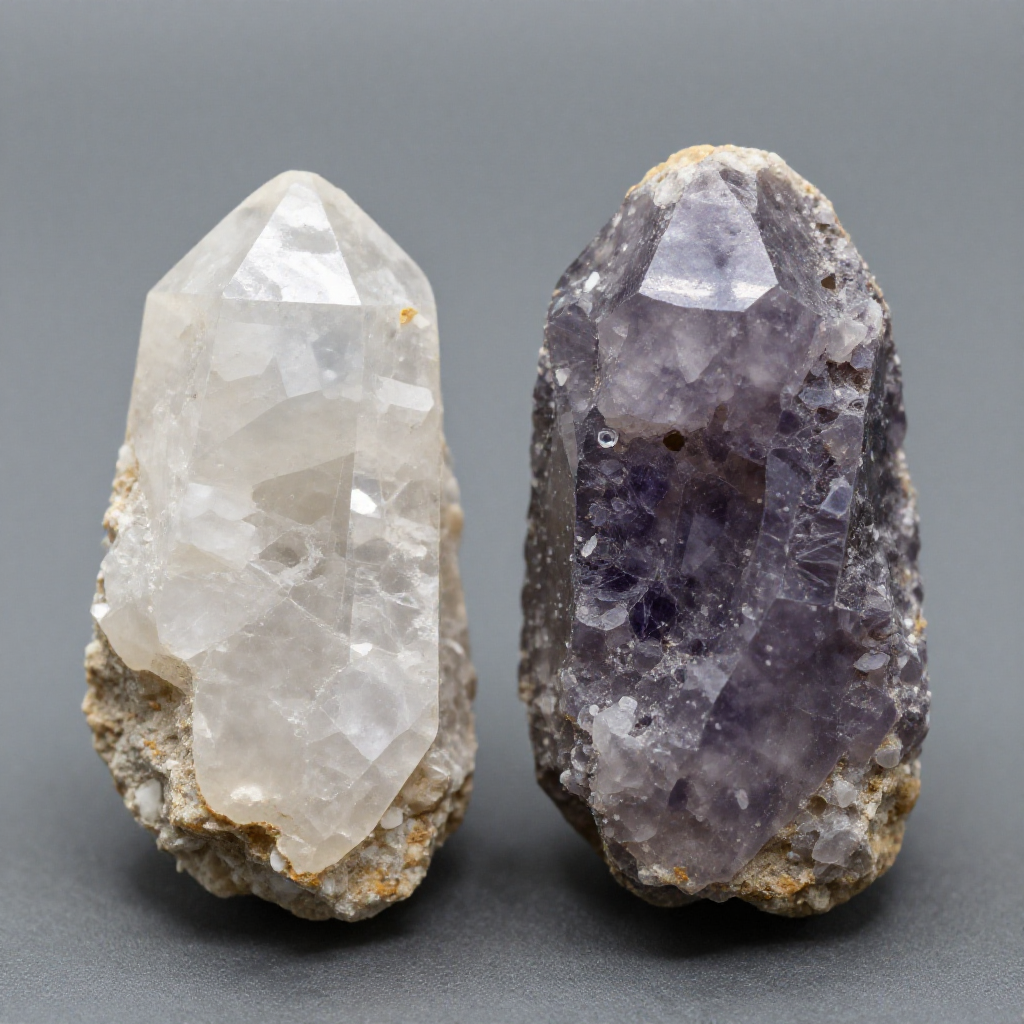
Quartz and calcite cause more misidentified rocks than any other mineral pair, and it's not close. Both show up clear, milky white, or lightly tinted. Both can grow into blocky or pointed crystals depending on the pocket they formed in. Sorting the two apart is one of the most common snags in rock and mineral identification, but it comes down to two tests you can run in under a minute with things you already own.
Check the Break Before You Test Anything
Pick up the piece and look at a broken edge, or snap off a small corner if you need one. Quartz breaks with a curved, shell-like surface, the same conchoidal fracture you'd see on a broken bottle or a flake of obsidian. There's no flat plane to it, just a smooth curve. Calcite does the opposite. It splits along flat, slanted faces that meet at consistent oblique angles, producing small rhombohedron-shaped blocks no matter how tiny the piece gets. That's cleavage, not fracture, and it's calcite's clearest signature. A flat, slanted break means calcite. A curved break means quartz.
Weight is where a lot of field advice oversells the difference. Quartz runs about 2.65 grams per cubic centimeter. Calcite runs about 2.71. That's roughly a two percent gap, nothing a hand can actually feel. If someone tells you to judge quartz versus calcite by heft alone, skip it. The break test above, plus the two tests below, will tell you far more than your palm ever will.
The Scratch Test Settles It Fast
Hardness is the reliable split. Quartz sits at 7 on the Mohs scale. Calcite sits at 3. That four-point gap means quartz scratches glass, which sits at 5.5, and a steel knife blade, also around 5.5, without much pressure, leaving a visible groove behind. Calcite won't touch either one. Try to scratch a knife blade with it and you'll polish the calcite's edge or leave nothing at all. Flip the test around and calcite loses again: a copper penny, at 3.5, scratches calcite easily but glides right over quartz without a mark. One scratch attempt against glass or a blade tells you which mineral is in your hand.
The Fizz Test Is the Tiebreaker
If the scratch test still leaves you guessing, or you don't want to risk marking the specimen, reach for vinegar instead. Calcite is calcium carbonate, and carbonate minerals react to acid by releasing carbon dioxide gas. A drop of white vinegar or lemon juice on a fresh, unweathered surface will fizz visibly, sometimes for several seconds. Quartz is silicon dioxide. It has no carbonate to react with, and a drop of vinegar just sits there and does nothing. Geologists carry dilute hydrochloric acid for the same reaction in the field. Vinegar and lemon juice are weaker, but the bubbles still show up clearly enough to call it.
Color and Clarity Won't Help You Here
Skip color entirely when you're trying to separate these two. Both minerals occur clear as glass, milky white, and tinted pink, yellow, purple, or gray by trace impurities. A clear, sharp-pointed crystal could be either mineral. Clarity is no better a clue; both can run from cloudy to gem-clear in the same deposit. The break, the scratch, and the fizz are what decide it, not the color.
Why the Mix-Up Actually Matters
This isn't just an academic distinction. If you're loading a rock tumbler, hardness is the entire game. A batch tuned for quartz, coarse grit and hours of tumbling, will grind soft calcite down to dust before the coarse stage even finishes. Toss a bucket you think is all quartz into the barrel, and any calcite mixed in comes out the other side rounded down to nothing, or pitted and dull next to the properly polished stones. Sort quartz from calcite before you tumble, not after you're disappointed with the batch. Rock tumbling and lapidary work runs on hardness math, and this is the first sorting call every batch depends on.
These two tests won't identify everything in your bucket, just the pair that trips up beginners most often. For a fuller five-step process that works on anything you can't place, see how to identify a rock you found.